
Fibromyalgia: 340,000 people, no recognised disease yet
About 340,000 people in the Netherlands have fibromyalgia: widespread chronic pain without a demonstrable cause. Fibromyalgia is still not officially recognised as a disease in the Netherlands, because there is no known biomedical cause. In March 2024, the Health Council advised the Minister of Health, Welfare and Sport to change this. This is still slow to change at the UWV and insurance doctors, who mainly look at what is objectively demonstrable.
Fibromyalgia is a chronic condition with widespread pain in muscles and connective tissue, often together with stiffness, extreme fatigue and concentration problems. There is no blood test or scan that confirms the diagnosis: it is made on the basis of the pattern of symptoms, after other rheumatic diseases have been excluded.
The problem is not that doctors are not familiar with fibromyalgia. The problem is the subsequent recognition: fibromyalgia is not yet recognised as a separate disease in the Netherlands, and because there is no measurable deviation, the severity of the symptoms is often questioned in practice, for example in a WIA assessment, where an objectifiable statement is requested.
This page does not provide medical advice. We show which pattern is repeating itself: a condition whose seriousness even the Health Council says must be taken seriously, but which must struggle for the same recognition in the practice of benefits and reintegration. For diagnosis and treatment, go to your GP or rheumatologist.
What this does to your life
Fibromyalgia costs energy that you do not have and requires a balance between exercise and rest that shifts daily. What works today may not work tomorrow, and that unpredictability is difficult for those around us to follow. It becomes extra difficult if the system itself also has doubts: during a re-examination, ask why you can no longer do it, while you have been fighting for years to prove that the pain is real.
How the diagnosis is made
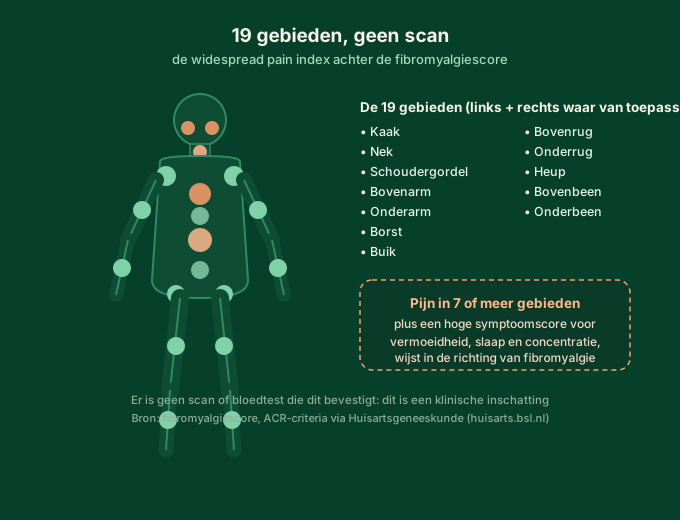
Fibromyalgia seems difficult to diagnose without a blood test or scan, but there is a system: the widespread pain index counts how many of the 19 recorded body areas you have pain, combined. with a score for fatigue, sleep and concentration.
Seven or more painful areas plus a high symptom score point towards fibromyalgia. It remains a clinical assessment based on a fixed, imitable system, not a shot in the air.
What you can expect from treatment
A more detailed overview of the complete treatment route can be found on the treatment page.
Building exercise
Regular, gradually built-up exercise reduces pain and stiffness over time, even if it feels counterproductive at first.
Multidisciplinary pain rehabilitation
A combination of physiotherapy, psychological support and sometimes medication, aimed at improving functioning with the pain.
Medication with limited effect
Pregabalin, amitriptyline or duloxetine may provide short-term relief for some people. See also the pregabalin dossier for the risks of long-term use.
What you can look out for
A complete overview of recognition points is on the recognition page.
Widespread pain
Above and below the waist, on both sides of the body, lasting at least 3 months.
Morning stiffness and fatigue
Extreme, persistent fatigue that does not go away with rest, often worse than the pain itself.
'Fibro fog'
Concentration and memory problems that further complicate daily functioning.
Why ZORGFUIBRRAND collects this
One story about a rejected WIA application for fibromyalgia is an individual drama. Thousands of stories together show that the system is structurally struggling with conditions without a biomarker, and that recognition on paper is different from recognition at the counter.
We do not ask for your medical file. We ask for your experience: how the diagnosis was made, and what happened when you then had to explain what you could still do.
"The Health Council says: take these symptoms seriously. During the re-examination the discussion starts again."
Frequently asked questions
What exactly is fibromyalgia?
How many people have fibromyalgia?
How is it diagnosed?
Is fibromyalgia a recognised disease?
Why is recognition by the UWV so sensitive?
Can fibromyalgia be cured?
What Zorgfuik does and does not do?
🏎 Need immediate help?
In case of immediate danger to yourself or someone else: call 112. Are you in distress or are you thinking about suicide? You can call or chat with 113 Suicide Prevention day and night via 0800-0113. Zorgfuik is not a crisis service and cannot solve acute requests for help, but we think it is important that you know where you can go.