
IBS: the stomach pain that you keep to yourself
It is estimated that 1 in 10 Dutch people have IBS. As many as two-thirds never seek help from a GP. Those who do often only receive a diagnosis after everything else has been ruled out. Shame keeps people away, and that's exactly where this trap starts.
IBS, irritable bowel syndrome, is a chronic condition with recurring abdominal pain and an altered bowel pattern: constipation, diarrhea, or an alternation of both. There is no visible abnormality in the intestine, which does not mean that the symptoms do not exist. That makes it slightly different from ACNES, where the pain comes from the abdominal wall and is at one fixed point: with IBS it concerns the intestine itself and the pain is related to the bowel movements.
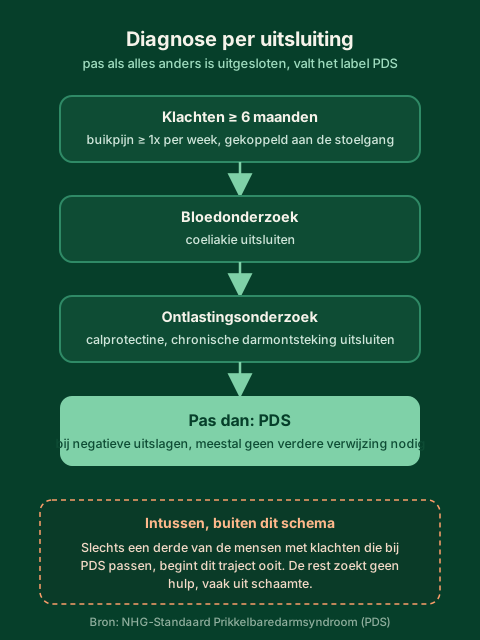
In practice, the diagnosis is often made through exclusion: first celiac disease, intestinal inflammation and other conditions are ruled out, and only if nothing comes of this, the label IBS is dropped. That process can take a long time, especially because many people wait a long time before talking to a GP about it.
This page does not provide medical advice. We show where the pattern often breaks down: shame that holds people back, a diagnosis that only comes after excluding other diseases, and a treatment that is often trial-and-error. For diagnosis and treatment, go to your GP.
What this does to your life
IBS is not a life-threatening condition, but it is one that structurally makes daily life smaller. Selecting toilets before planning a trip, canceling parties for fear of a bloated stomach, avoiding exercise: it is tiring to constantly take into account a body that reacts unpredictably. Precisely because it concerns bowel movements and abdominal pain, people hardly talk about it, not even with their GP.
Why the diagnosis takes so long
IBS is not detected with a test, but is achieved through a process of exclusion: first celiac disease, then inflammatory bowel diseases. Only if nothing comes out of this will the IBS label be assigned.
That process in itself is not the biggest problem. The biggest problem is that most people with symptoms never start this process, out of shame, and therefore never arrive at the outcome.
What you can expect from treatment
A more detailed overview of the complete treatment route can be found on the treatment page.
Lifestyle and fiber first
Eating regularly, sufficient exercise and soluble fibers such as psyllium are often the first step.
The low-FODMAP diet, under supervision
If the effect is insufficient, a dietician supervises a temporary elimination diet: research shows a reduction in symptoms in 68 to 87% of people who follow it.
Psychological treatment demonstrably works
Hypnotherapy and cognitive behavioral therapy reduce intestinal symptoms via the gut-brain axis, even though this feels counter-intuitive.
What you can look out for
A complete overview of recognition points is on the recognition page.
Recurring abdominal pain
At least 1 day per week for the past 3 months, linked to bowel movements.
One of three types
IBS-C (constipation), IBS-D (diarrhoea) or IBS-M (alternating): treatment differs per type.
None alarm symptoms
Blood in the stool, night pain or unintentional weight loss are not part of it and always require further investigation.
Why ZORGFUIBRRAND collects this
One story about IBS is quickly dismissed as 'a sensitive stomach'. Thousands of stories together show that shame is a structural reason why people seek help too late or never, and that this is precisely where something can be improved.
We do not ask for your medical file. We ask for your experience: how long did you wait before you brought it up to your GP, and what held you back.
“Ten percent of the Netherlands suffer from it. Hardly anyone talks about it.”
Frequently asked questions
What exactly is IBS?
How many people have IBS?
Do I always have to go to the GP with abdominal symptoms?
Does the FODMAP diet really work?
Why does psychological treatment help with an intestinal problem?
What Zorgfuik does and does not do?
🏎 Need immediate help?
In case of immediate danger to yourself or someone else: call 112. Are you in distress or are you thinking about suicide? You can call or chat with 113 Suicide Prevention day and night via 0800-0113. Zorgfuik is not a crisis service and cannot solve acute requests for help, but we think it is important that you know where you can go.