
ADHD diagnosed later in life: when no one adds it all up
Being told at forty that you have ADHD. For many people who grew up in the seventies and eighties, a whole world opens up. But the real trap sometimes begins afterwards: when you have several diagnoses, each with separate clinicians who do not coordinate with one another.
I got my ADHD diagnosis when I had just turned forty. A whole world opened up for me. Suddenly it had a name: the always being switched on, the thirty browser windows open at once, the feeling that I was never really understood.
Anyone who grew up in the seventies and went to school in the eighties never heard that name. Neurodiversity did not exist as a concept. You were just hyperactive, or annoying, or daydreaming. In my case it was mostly boredom: my mind went too fast for what was happening around me.
This page does not give medical advice. What we do is show where people with a late ADHD diagnosis get stuck in the care system, and where things go wrong when you have several diagnoses at once. A large part comes from lived experience.
Maybe you recognise this
Always on
Workaholic, thirty tabs open, going from one thing to the next. Not because you have to, but because standing still is almost impossible.
Checking out in conversations
You think in twenty steps and four paths at once, including the way back. A conversation that goes slowly sometimes just loses you: too slow, and therefore boring.
Reading takes effort
For me, school was always hard going. After a few lines of reading I start to glaze over. The words do not stick, my attention shoots off.
Never really understood
The feeling that you are wired just a little differently from everyone else, without knowing why. Until a diagnosis finally gives it an explanation.
A personal detail: I read every word I type in my head. That is called subvocalisation and it is quite normal in itself, almost everyone does it. But combined with a mind that keeps shooting off, it makes reading and writing extra tiring. It is exactly that kind of small thing that you only understand after a diagnosis: why they weigh more heavily for you.
“A whole world opened up for me. Suddenly I had not been lazy or annoying. There was simply an explanation.”
A late diagnosis often gives recognition above all. Not an immediate solution, but peace of mind: it was not your fault as a person.
Where the trap was for me
For me the trap was not in the diagnosis, nor in a psychiatrist who failed to think along. On the contrary: my psychiatrist thought along very well. The trap was in something else: I have several diagnoses, and for those I had a set of separate clinicians who in many cases did not coordinate or think along with each other.
Fortunately my psychiatrist and my psychologist worked at the same mental health institution, so that coordination was there. But with the gastroenterologists who treated my stomach and bowel complaints, there was simply no coordination. And that began to grate, because the treatments clashed. One doctor prescribed a medicine, while the other said that the very same medicine impaired the effect of another drug.
The vicious circle
Besides ADHD I also have ACNES (chronic abdominal wall pain) and struggle with depression. Those three interlock, and that makes treatment extremely difficult.
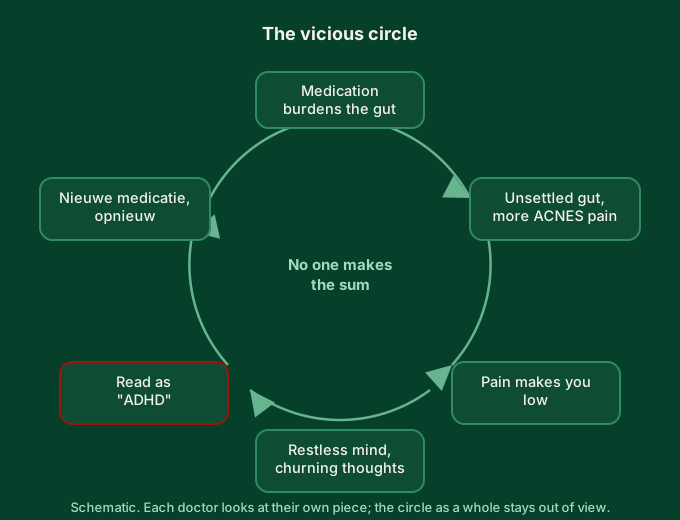
Medication often hits your gut. An unsettled gut gives me more ACNES pain. That pain makes me low. Low mood gives a restless mind and churning thoughts. And that is then seen as ADHD. So the circle goes round, and the heart of the problem is that no one adds it all up: each doctor looks at their own piece.
Searching for a baseline that never came
I have been through quite a few pills. One turned me into a zombie, another gave me enormous rebounds as soon as it wore off. And because I have also had a gastric bypass, I tolerate long-acting, slow-release medication poorly: my body simply absorbs it differently.
On top of that comes the complexity of several diagnoses. With ADHD, depression and chronic pain all mixed together, it was almost impossible to measure what was doing what. I was never able to find a good baseline, no point of rest from which you can see whether something works.
At a certain point I was taking so much ADHD medication, around 2,190 pills a year in total, that I decided to stop. I did not do that on my own, but in consultation with my psychiatrist and tapered off calmly, after I had genuinely given it a thorough try. Since then I try to manage with my neurodiversity itself. The need for something long-term is still there, but with ACNES, depression and ADHD all at once it is hard to find.
What I want to pass on to others: this is my story, not advice to stop. For a great many people, medication does work. The point is not that the pills are bad, the point is that no one made the sum of my body and my diagnoses.
When you almost become your own doctor
One of the things I recognise most from this journey: at a certain point you almost become your own clinician. You start proposing different doses or combinations yourself, because you are the only one who sees all the pieces together. In my case people did think along, even if it was sometimes off-label.
That people thought along with me was a stroke of luck. But it also says something: that the patient has to take charge themselves actually means the system is leaving that coordination undone. Not out of a doctor's unwillingness, but because no one sees the whole.
Who can actually add it all up
Ask your clinicians to coordinate
If you have several clinicians, explicitly ask whether they can be in contact with each other. Within the same institution that often happens automatically, between different institutions usually not. You are perfectly entitled to ask for it.
Keep everything at one pharmacy
Your pharmacy can do medication monitoring and warn you if two drugs get in each other's way. That only works if all your medication is known at the same pharmacy. Discuss any doubts about interactions with your doctor or pharmacist.
Keep your own overview
Note which diagnoses you have, who treats you and what you take. That way you do not have to start from zero with every new doctor, and you see for yourself the connections that otherwise disappear between the partitions.
Ask about a lead clinician
In mental health care there is often a lead clinician who oversees your journey. Ask who that is for you and whether they can also liaise with your other care providers. One person guarding the whole makes an enormous difference.
Find free support if you get stuck
If you cannot work it out, an independent client support worker can think along with you and come with you to appointments. That is free of charge and you do not have to do it alone.
Why Zorgfuik collects this
One story about clashing treatments is bad luck. Hundreds of stories together show a pattern: that care is chopped up into separate pieces, and that no one is responsible for the whole. People with several diagnoses fall right through the gaps.
That is why we do not ask for your records or your name. We ask for your experience, so it becomes clear how often coordination is missing and where things must improve.
“Every doctor was right about their own piece. Put together, none of it added up.”
Frequently asked questions
Why do people often only get an ADHD diagnosis later in life?
What is the use of a diagnosis when you are already an adult?
Why is ADHD medication sometimes so hard to get right?
What if I have several diagnoses with different clinicians?
Can medication from one doctor clash with that of another?
What does Zorgfuik do and not do?
🏎 Need help right now?
If there is immediate danger to yourself or someone else: call 112. Feeling low or having thoughts of suicide? In the Netherlands you can call or chat day and night with 113 Suicide Prevention via 0800-0113. Outside the Netherlands, contact your local emergency line. Zorgfuik is not a crisis service and cannot resolve urgent help requests, but we think it matters that you know where you can turn.