
ACNES: unexplained abdominal pain that goes missed for years
Sharp jabs just beside your navel, pain that radiates to your side or back, and tests that keep finding nothing? It could be ACNES: pain coming from the abdominal wall, not from your organs. It is often missed for years, while you go from specialist to specialist.
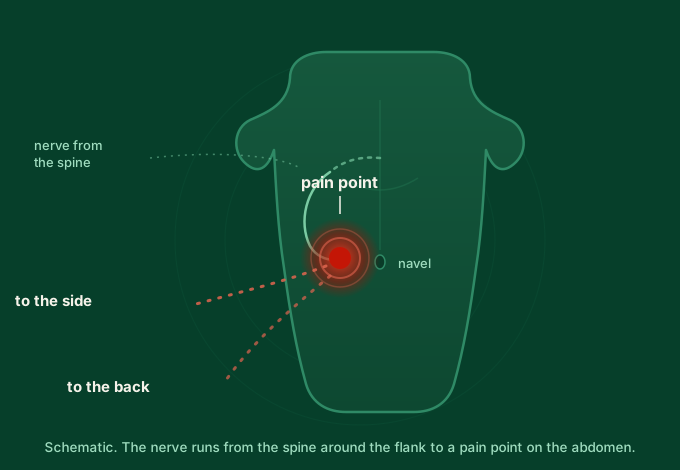
ACNES stands for Anterior Cutaneous Nerve Entrapment Syndrome. In plain terms: a skin nerve gets trapped in the abdominal wall and produces intense, often sharp or burning pain in a small spot. Many people feel it to the right or left of the navel, and the pain can radiate to the side or even the back, because that is how the nerves run.
Because the pain comes from the abdominal wall and not from the organs, ultrasounds, scans and blood tests usually show nothing. And that is exactly where the trap begins. When the standard tests find nothing, the search moves on to the next test, the next specialist, the next waiting list. Sometimes you are eventually told it must be in your head. While the pain is real and was simply being looked for in the wrong place.
This page does not give medical advice. What we do is show where people with unexplained abdominal pain get stuck in the care system, what the journey can look like, and what direction you can ask for. A large part comes from lived experience, because the founder of Zorgfuik went through the entire journey himself.
What it is like to live with this
ACNES pain is hard to explain to someone who does not know it. In my case it feels as if there is a piece of barbed wire on the right side of my belly that gets pulled tight with every wrong move or breath. The pain starts to the right of the navel and pulls through to the side and sometimes into the back.
It is not the big things that make your life smaller, it is the ordinary, everyday moments when the pain shoots through.
Working
Getting through a workday with pain that never lets up drains your energy. Sitting, lifting, standing for long: anything can trigger a flare. For many people, work becomes hard or even impossible.
Exercise
Movements you never used to think about become a minefield. Bending, twisting, tensing your belly: exactly the things you do in sport are the things that set the pain off.
Sleeping on your side
The one position in which you finally drift off presses on exactly the wrong spot. Sleeping through the night becomes rare.
Yawning or coughing
You unconsciously tense your belly and the pain shoots in. Something that should be a reflex becomes something you dread.
An hour in the car
The posture, the seatbelt, the vibrations. And then that one bump or pothole you spot just too late: it feels like a knife.
Activities and plans
A day out, a birthday, doing something with your family: you start weighing it in advance against the pain it will cost. More and more often you cancel, and so your world slowly gets smaller.
It is not one of these things, it is all of them together. I used to be a handyman with a high pain threshold who did not shy away from anything. Now I often end up passive on the sofa, purely to protect myself from the pain. That is how ACNES makes your world smaller, bit by bit.
“I used to be able to take a lot. Now stubbing my toe feels like I could call an ambulance. As if my pain threshold has been reversed.”
That feeling has a name: central sensitisation. You have not become soft, your nervous system has become oversensitive to stimuli. Read what that means ›
The search that never seems to end
Before ACNES came into view, I kept knocking on the gastroenterologist’s door. At first the pain was thought to come from my earlier gastric bypass, then from another abdominal hernia. I had several ultrasounds, including of the bile ducts, because colic was suspected at first. Each time a new test, each time nothing, each time another waiting list.
What makes it extra hard: I have been to so many places where they did not even know what ACNES was. You explain your own story over and over, and you notice you are the only one trying to keep track of the whole picture.
A kind of medication guinea pig
My ACNES developed after several procedures. I think the turning point was a complication during a first operation on my gallbladder, in which my pancreas was also affected. I spent a week in hospital and had a second operation a week later. From that moment it went from colic to chronic pain, and it has never gone away again.
In the search for relief I became a kind of medication guinea pig, a light term for something that often did not feel light at all. I was put on pregabalin and soon went from 75 to 150, to 225, to 300 milligrams, twice a day. A never-ending story: the pain was dampened a little, but never enough to function properly.
That whole process takes an enormous amount of time. Not just the treatments themselves, but the conversations around them, the explaining, starting over with each new doctor. And all that time you simply live on with the pain, while trying to work, sleep and be there for the people around you.
I am not sharing this for sympathy, but because I know how lonely it is when no one can place your pain. If you are reading this and you recognise it: you are not crazy, and it is not in your head.
What ACNES does to your life and your mind
ACNES can wreck your career and your future. Work becomes hard or impossible, and you can lose your job, your income and part of your identity. Chronic pain that goes unacknowledged also eats away at you inside. It can lead to low mood, despair and, for some people, to dark thoughts or thoughts of suicide.
If you recognise that: you are not alone in it, and you do not have to keep carrying it by yourself. Talking helps, and there is support available day and night.
What a treatment journey can look like
Important first: what follows is general information, not advice and not an order that applies to everyone. Which treatment is appropriate is always decided by a doctor, usually via a pain clinic. It does help to know which steps exist, so you can have the conversation with your clinician. The descriptions below reflect care as organised in the Netherlands.
Injections with a local anaesthetic
Often the first step: an injection with a numbing agent into the painful spot in the abdominal wall. Sometimes that gives temporary relief. In my case the pain actually got worse for the first two weeks before it eased a little. Lidocaine injections sometimes helped me for a day, after which the pain returned.
TENS: stimulation through the skin
TENS stands for transcutaneous electrical nerve stimulation: small electrodes on the skin deliver light electrical pulses to dampen the pain. It is non-invasive and is often reimbursed in the Netherlands. Whether it helps varies a lot from person to person. I tried it for a long time, but in the end it gave more pain than relief. TENS is not suitable in every situation, for example with a pacemaker or certain heart conditions, so this always happens in consultation with the pain clinic.
Anterior neurectomy (surgery)
If injections and TENS do not provide lasting enough relief, surgery can follow in which the trapped nerve is located and released. This is usually the first surgical step.
Posterior neurectomy (last surgical option)
If the pain returns afterwards or does not ease enough, a posterior neurectomy may be considered. This is often seen as the last surgical option, the last hope of relief. Whether this is appropriate is judged by the treating doctor.
Who can actually look into it
Name ACNES to your GP
Ask specifically whether the pain could come from the abdominal wall rather than the organs. By naming ACNES, you put it on the trail that is otherwise often skipped. Your GP is your starting point and can refer you specifically.
Ask about the abdominal wall test
There is a simple test in which the doctor locates the painful spot and checks whether it gets worse when you tense your belly. This is something to discuss with your doctor.
Ask for a referral to a pain clinic or specialised centre
In the Netherlands there are treatment centres that focus specifically on abdominal wall pain. There they know the picture and do not have to rule everything out from scratch first. Ask your GP whether such a referral is appropriate.
Keep your own records
Note which tests have already been done and what they showed. That way you avoid starting from zero with every new doctor, and you keep the overview the system often loses.
Find free support if you get stuck
If you cannot work it out with the care system, an independent client support worker can think along with you. That is free of charge and you do not have to do it alone.
Why Zorgfuik collects this
One story about years of missed ACNES is a personal tragedy. Hundreds of stories together show a pattern: that care is organised around organs and structurally overlooks the abdominal wall. That pattern is what we want to make visible.
That is why we do not ask for your records or your name. We ask for your experience, so it becomes clear how often abdominal wall pain is missed and where things must improve.
“How often does the same pain have to be missed before it gets called a pattern?”
Frequently asked questions
What is ACNES?
What are the symptoms of ACNES?
Why does it take so long for ACNES to be recognised?
What is central sensitisation?
What treatments are there for ACNES?
What is an anterior and posterior neurectomy?
What does Zorgfuik do and not do?
🏎 Need help right now?
If there is immediate danger to yourself or someone else: call 112. Feeling low or having thoughts of suicide? In the Netherlands you can call or chat day and night with 113 Suicide Prevention via 0800-0113. Outside the Netherlands, contact your local emergency line. Zorgfuik is not a crisis service and cannot resolve urgent help requests, but we think it matters that you know where you can turn.