
PTSD: good treatment exists, almost no one gets it completely
Of all Dutch people who had PTSD at some point in their lives, only 29.7 percent received treatment that meets the guideline. With complex PTSD, the more serious variant after long-term trauma, it is even more difficult: that diagnosis does not even officially exist in the Dutch classification system, and is therefore often confused with an anxiety disorder or borderline.
PTSD, post-traumatic stress disorder, arises after experiencing or witnessing a traumatic event. event. Characteristic are re-experiencing, avoidance of memories of the trauma, negative thoughts or mood, and an increased state of alertness.
Complex PTSD (CPTSD) usually develops after long-term trauma, often in childhood, and in addition has problems with emotion regulation, a negative self-image and difficulty with relationships. In the ICD-11, the international classification, CPTSD has been a separate diagnosis since 2022. In the Dutch system (DSM-5) this separate category does not exist, which makes recognition difficult.
This page does not provide medical advice. We show which pattern repeats itself: a condition with proven effective treatments, which are nevertheless never fully implemented in a large proportion of people. For diagnosis and treatment, go to your GP or the GGZ.
What this does to your life
Trauma that is not processed does not disappear, it shifts into the background and resurfaces at the most inconvenient moments. Sleep, relationships and work all suffer from the constant state of alertness. In addition, with complex PTSD, your own sense of who you are is affected, making it more difficult to even recognise that something treatable is going on.
The gap between existing and getting
There is no shortage of proven treatments for PTSD: EMDR and trauma-oriented cognitive behavioral therapy have been the first choice for years, and the guideline has recently been expanded to include even more options.
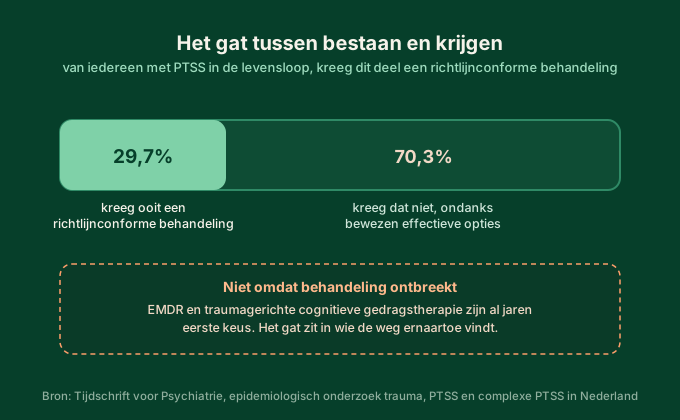
The problem is getting there. Of all Dutch people with PTSD in their lives, only 29.7 percent ever received treatment that complies with the guideline.
What you can expect from treatment
A more detailed overview of the complete treatment route can be found on the treatment page.
Trauma-oriented psychotherapy as the first choice
EMDR or trauma-oriented cognitive behavioral therapy, directly aimed at processing the traumatic memory.
A broader palette than before
In addition to EMDR and CBT Cognitive Processing Therapy, Imaginary Rescripting, BEPP, NET and writing therapy have now also been recognised.
Do not necessarily stabilize first
Recent research shows that immediately starting with trauma processing is just as safe and effective as first a stabilization phase.
What you can look out for
A complete overview of recognition points is on the recognition page.
Reexperiencing and avoidance
Unwanted, recurring memories, and avoiding places, people or conversations that are reminiscent of the trauma.
Increased alertness
Start reactions, irritability and difficulty relaxing, even in safe situations.
In complex PTSD: more than that
Problems with regulating emotions, a persistent negative self-image and difficulty relating to others trust.
Why ZORGFUIBRRAND collects this
One story about a missed PTSD diagnosis is a personal tragedy. Thousands of stories together show that the gap is not in the lack of proven treatments, but in the road to it: insufficient questioning, confusion with other diagnoses, and a classification system that does not yet separately recognise complex PTSD.
We do not ask for your medical file. We ask for your experience: which diagnosis you first received, and how long it took before trauma became a topic of discussion.
“Almost seventy percent do not receive the treatment that has been around for a long time and has worked for a long time.”
Frequently asked questions
What is the difference between PTSD and complex PTSD?
How many people have PTSD in the Netherlands?
Why is complex PTSD often missed?
Which treatments work for PTSD?
Do you first have to stabilize before working on the trauma?
What Zorgfuik does and does not do?
When chronic pain and PTSD reinforce each other
PTSD does not only occur after an accident, violence or disaster. Research among people referred for pain rehabilitation also found PTSD in 9.5 to 34.7 percent of them. Persistent, unexplained pain such as ACNES can itself become a form of trauma: a body that you no longer trust, a system that you did not believe in for years. Conversely, PTSD can actually increase the body's sensitivity to pain, through the same process of central sensitization described on the ACNES page.
This means that startle reactions to pain, or panic to a recurring twinge, are not an exaggerated reaction. It is a well-known, described pattern in which the body and nervous system remain on alert. If this is recognizable, that is a reason to discuss it with both a pain practitioner and a trauma practitioner, not with one of the two alone.
🏎 Need immediate help?
In case of immediate danger to yourself or someone else: call 112. Are you in distress or are you thinking about suicide? You can call or chat with 113 Suicide Prevention day and night via 0800-0113. Zorgfuik is not a crisis service and cannot solve acute requests for help, but we think it is important that you know where you can go.