
Autism in children: signs at 18 months, diagnosis at 4 or 5 years
In many children, the first signs of autism are already visible around 18 months. Yet they are often not diagnosed until the age of four or five, sometimes even later. In the meantime, parents are regularly sent from pillar to post, and autism has the longest waiting time of almost any mental health diagnosis.
Autism is congenital, but that does not mean that it is immediately visible. The first signals in young children are subtle: excessive crying or being very quiet, not waving or greeting, and overreacting to sounds. Parents are often the first to notice that something is different.
The problem is not the lack of signals. It is the time between the moment that parents start to worry and the moment that a diagnosis and appropriate help actually arrive. Officially, a diagnosis can be made as early as 24 months, but in practice many children do not receive it until they are four or five, sometimes later.
This page does not provide medical advice. We show the pattern that repeats itself: early signals that are present, parents who are concerned and are sent from agency to agency, and waiting times that are among the longest in all of youth mental healthcare. For a diagnosis, go to your GP, the child health clinic or the youth doctor.
What this does to your life
For a child, a late diagnosis means missed years of appropriate support at a time when the brain is still developing most rapidly. For the family, it means years of searching without clarity, tensions between partners, and brothers and sisters who grow in a household under constant uncertainty. In addition, in teenagers, compensatory strategies that worked previously often break down during puberty.
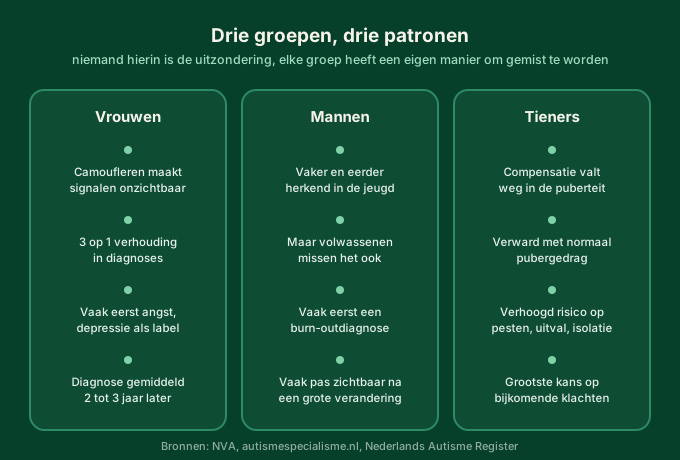
Three groups, three patterns
Women, men and teenagers are all missed at times, but not in the same way and not for the same reason. In children, the problem is not the lack of signals, but the time to diagnosis and help.
That is exactly why this page is next to the women's and men's file, not behind it: it is its own pattern with its own approach.
What you can expect from treatment
A more detailed overview of the complete treatment route can be found on the treatment page.
Early intervention works best
The sooner appropriate help starts, the greater the development opportunities for the child. child.
Family guidance, not just child care
Parents and any siblings need support just as much as the child itself.
Educational support for school-age children
Adjustments at school, from extra guidance to a quiet workplace, often make the difference between dropping out and participate.
What you can look out for
A complete overview of recognition points is on the recognition page.
Early signals around 18 months
Consider not waving, not making eye contact, or reacting extremely strongly to sound or change.
Relapse in development
Previously acquired language or social skills that disappear again is a signal that should always be taken seriously.
Puberty as a breaking point
Characteristics that could previously be compensated for often fail in secondary education.
Why ZORGFUIBRRAND collects this
One story about a child who only received the right help at the age of five is an individual drama. Thousands of stories together show that the delay is not due to the signals, which are often there early, but to a system in which parents are sent from pillar to post and the waiting time itself is one of the longest in all of mental healthcare.
We do not ask for your child's medical file. We ask for your experience as a parent: when you first noticed something, and how long it took before help arrived.
“We already saw it when he was eighteen months old. At the age of four we finally got a name.”
Frequently asked questions
When do the first signs of autism appear?
From what age can autism be diagnosed?
How long is the waiting time for autism care in mental healthcare?
Why is puberty a vulnerable period?
What can I do as a parent if I am worried?
Are there also files about this? autism in women or men?
What Zorgfuik does and does not do?
🏎 Need immediate help?
In case of immediate danger to yourself or someone else: call 112. Are you in distress or are you thinking about suicide? You can call or chat with 113 Suicide Prevention day and night via 0800-0113. Zorgfuik is not a crisis service and cannot solve acute requests for help, but we think it is important that you know where you can go.