
Autism in men: already visible in childhood, yet only connected late
Boys are recognised more often and earlier than girls, that is true. But that doesn't mean the system works well for men. In adult men, the diagnosis is often only made after a major event: living together, having a child, or getting stuck at work. The characteristics were there much earlier, just never with a name.
Autism in men is recognised more often and faster than in women, that is a real difference. The diagnostic criteria have historically been based on men, and classic characteristics such as posture, facial expressions, eye contact and way of speaking are more noticeable in boys.
That early signal does not mean that the path will follow automatically. Research from the Dutch Autism Register shows that the male-female ratio in diagnoses is probably around 2 to 1 to 3 to 1, much lower than the 4 to 10 to 1 that was long assumed. In adult men, the diagnosis is often only made after life becomes more complex: living together, having a child, or getting stuck in a job.
This page does not provide medical advice. We show which pattern repeats itself: characteristics that were visible from childhood, but were only given a name years later, usually when life itself no longer accommodated the adjustment. For diagnosis you go to your GP or a specialized diagnostic center.
What this does to your life
Undetected autism means years of feeling that you have to work harder than others to achieve the same thing, without knowing why. Relationships, parenting and work all require flexibility and social coordination that do not come naturally. Without explanation, this is quickly read as unwillingness, rigidity, or insufficient adaptability, while there is another explanation.
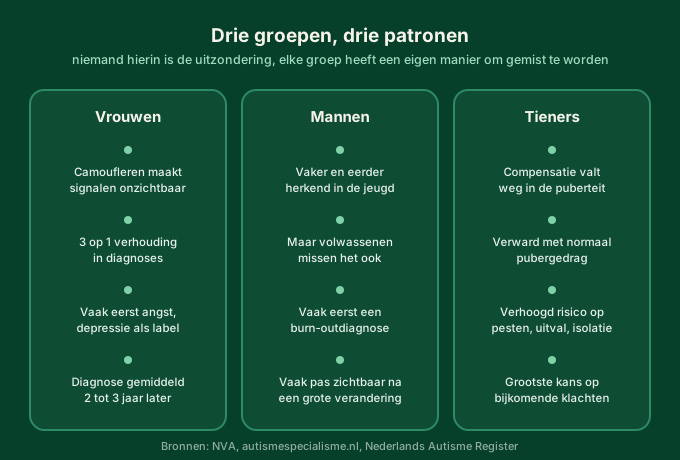
Three groups, three patterns
Women, men and teenagers are all missed sometimes, but not in the same way and not for the same reason. For men, the starting point often lies with a major life change, not with camouflage as with women.
That is exactly why this page is next to the women's file, not behind it: it is its own pattern with its own approach.
What you can expect from treatment
A more detailed overview of the complete treatment route can be found on the treatment page.
Recognition and self-insight
A diagnosis provides a framework for patterns that you have known all your life, without previously having a name for them. had.
Coaching on work and relationships
Targeted guidance helps with the two areas where men with autism most often get stuck: work and partner relationships.
Adjustments that really make a difference
Clear agreements, fewer varying tasks and space to recover after social exertion noticeably reduce the daily burden.
What you can look out for
A complete overview of recognition points is on the recognition page.
Visible since childhood
Classic features that were noticed early on, but never led to a diagnosis
Difficulty switching
A sudden change in plan or approach takes noticeably more energy than most people.
Only visible when major changes
Living together, having a child or a new job are typical moments when symptoms increase.
Why ZORGFUIBRRAND collects this
One story about a man who was not diagnosed until he was forty is a personal story. Thousands of stories together show that early recognition in boys does not automatically mean that the same recognition actually reaches adult men.
We do not ask for your medical file. We ask for your experience: which moment in your life prompted you to have research done, and what preceded it.
“The characteristics were already there when I was ten. It took until I was thirty-five before a name was given.”
Frequently asked questions
Why are boys diagnosed more often than girls?
What is the actual ratio between men and women with autism?
Why is autism still missed in adult men?
What problems do men with autism encounter most often?
What support is available for adult men with autism?
Are there also files on autism in women or children?
What Zorgfuik does and does not do?
🏎 Need immediate help?
In case of immediate danger to yourself or someone else: call 112. Are you in distress or are you thinking about suicide? You can call or chat with 113 Suicide Prevention day and night via 0800-0113. Zorgfuik is not a crisis service and cannot solve acute requests for help, but we think it is important that you know where you can go.